
Beyond Euclid #224
Welcome to Beyond Euclid #224, the newsletter for the best mathematics and science stuff of the week. I am Ali, and I curate cool math and science stuff every week to help you have a better week.
Hello from Beyond Euclid 224, a couple of days later than usual. The road got in the way this time, and I'm sorry for the wait. This issue wandered into some strange company. A horse that pretended to do math. A theorem solved by a dead man in a dream. Bananas sold by ripeness. Bots quietly outnumbering us online. Bees that turn out to be smarter than we gave them credit for. There's lighter stuff too — a man who used AI to undo every Game of Thrones death, a ship-shaped kite, and quite possibly the best lawnmower video ever filmed.
Still free, still weekly, still written long after the kids are asleep. If these issues have become part of your week, the single most useful thing you can do is become a paid subscriber on Substack or chip in on Patreon — that's what actually keeps the lights on here. And if money's tight, forwarding this to one person who'd love it is worth more than you'd guess.
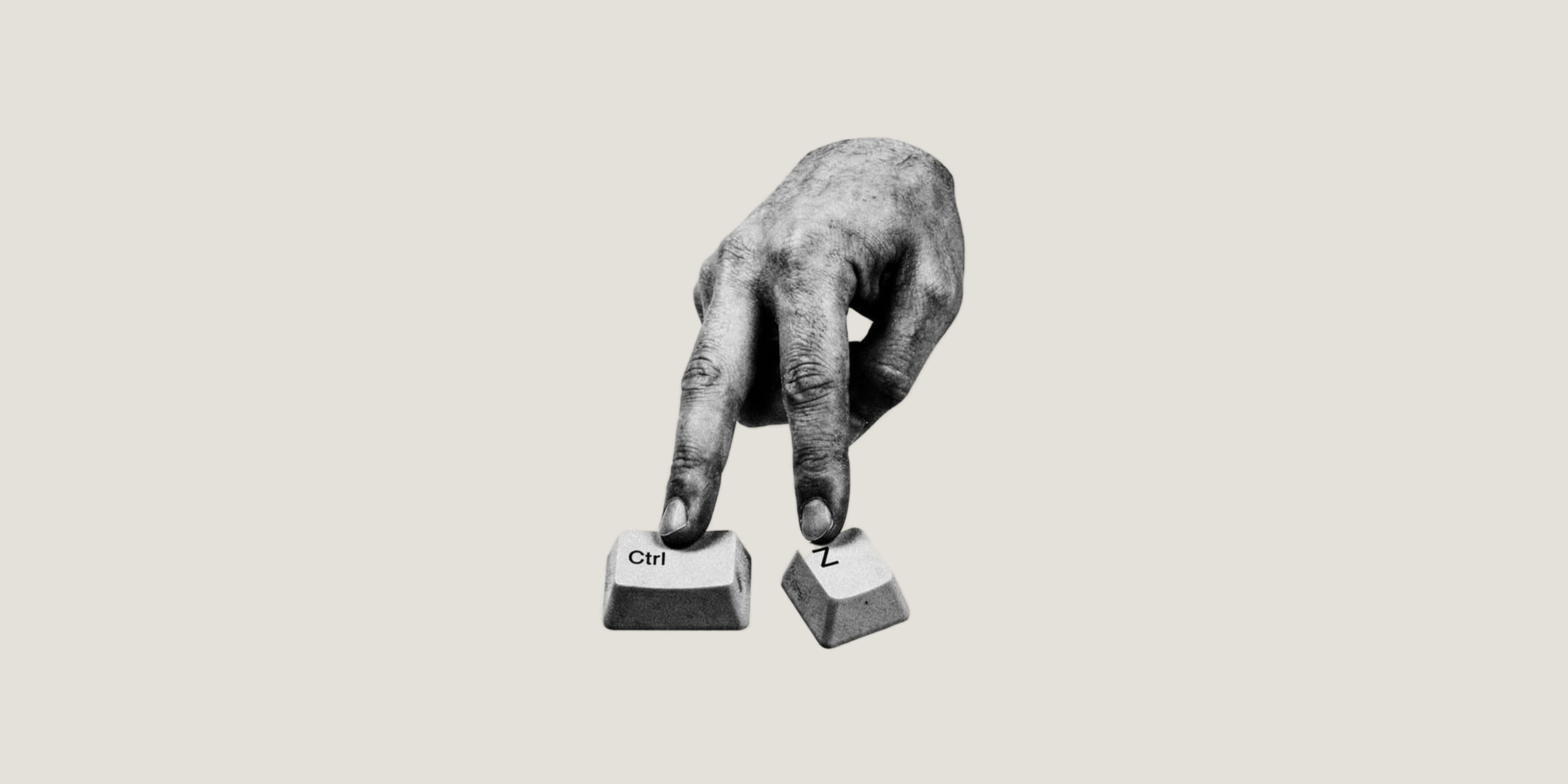
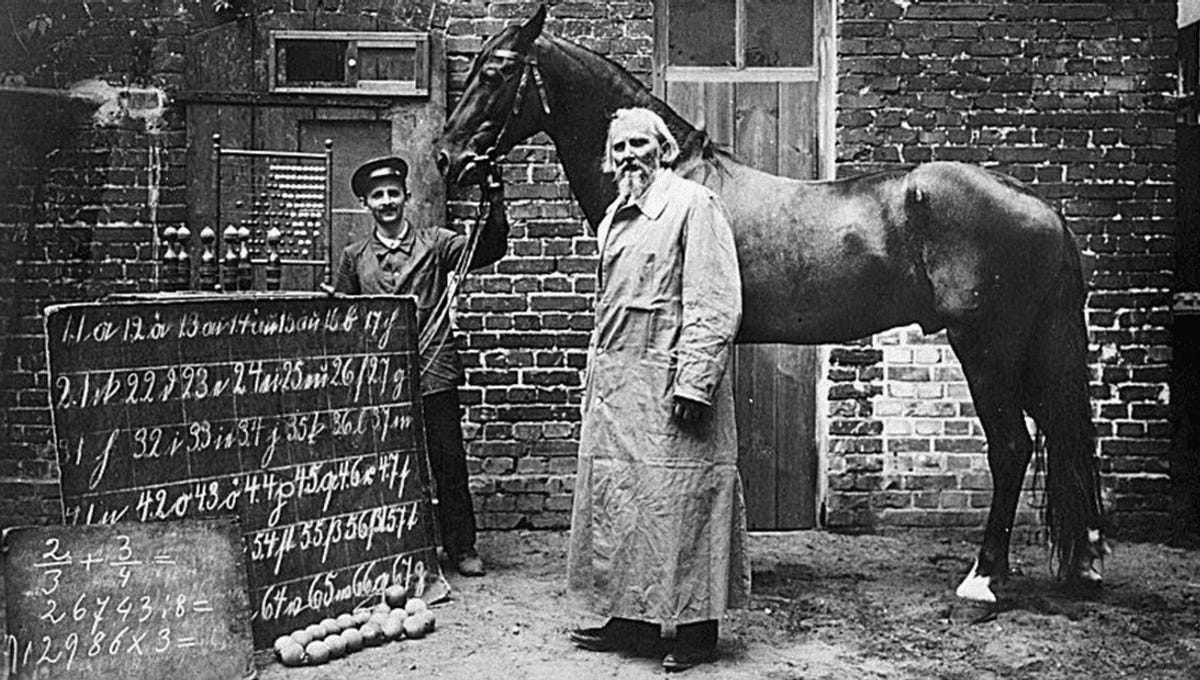
🐴In early 20th-century Berlin, a horse mesmerized crowds by doing mathematics. Known as Clever Hans, the horse answered addition, multiplication, even square-root and fraction questions by tapping his hoof, spelled out words by turning letters into taps, told the time and even worked out calendar dates. When a commission found no trickery in 1904, the young psychologist Oskar Pfungst took over. Whenever the questioner did not know the answer, Hans’s success collapsed. Pfungst showed that the horse was actually reading the tiny bodily signals the questioners gave off without realizing it. The face and neck muscles that tensed as the correct number approached relaxed at the final tap, telling Hans to stop. So Hans did not know any mathematics, but he read people extraordinarily well. Today, researchers unknowingly steering their subjects is called the “Clever Hans Effect,” and this story is exactly why double-blind experiments are necessary.
👻In January 1988, a mathematician woke up with the key to a problem he had been stuck on for three years. A close friend who had taken his own life 94 days earlier had whispered the idea to him in a dream. Robert Thomason had earlier dismissed that path as a dead end, but the dream was so insistent that he sat down, worked it through again, and saw the idea was right. In the landmark 189-page paper published in 1990, he listed his friend Tom Trobaugh as a coauthor.
🕳️For the first time, astronomers have directly measured the mass of a dormant black hole in the early universe. Active black holes glow as they devour gas, but this one is silent and invisible. The team weighed this giant, 6 billion times the mass of the Sun, by watching the motion of the stars around it. The galaxy is 10 billion light-years away and a measurement at that distance is normally impossible, but it became possible because an intervening cluster of galaxies acted as a lens and magnified the galaxy about 30 times.
⛽According to one analysis, the average American household has paid about 450 dollars extra on energy because of the Iran war. Since the war began on February 28, consumers have collectively shelled out nearly 60 billion dollars. Half of that comes from gasoline, with the price up 47% since early March to 4.39 dollars a gallon. Diesel jumped by a similar amount, and the rise in jet fuel pushed airfares up more than 20% in a year. The striking part: this 450-dollar hit completely wiped out the 384-dollar-per-household relief from the tax cut. At this rate, by the war’s one-year mark the bill could approach 2,000 dollars per household.
🛩️Some guy, starting from the idea that “when disaster strikes, the rich will be the first to fly out,” built a strange early-warning system called Apocalypse Early Warning System. The site tracks more than 35,000 private and business jets worldwide with live flight data and compares how many are airborne at any moment against the historical average, giving an “emergency level” from 1 to 5. The most striking part: his theory was confirmed when many jets took off before the Iran–U.S. war broke out.
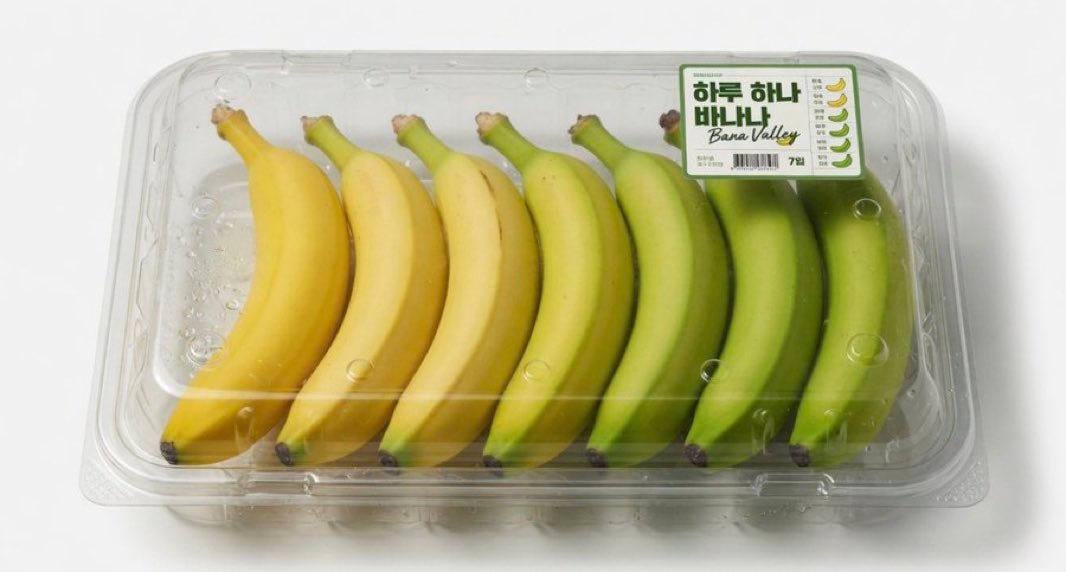
🍌This week I learned that the Korean retail chain E-Mart sells a “one a day banana” pack. The six bananas in the box are arranged in order of ripeness, from most ripe to least, so each day you start with the ripest one and avoid having a whole bunch go brown on you at once.
🤖According to Cloudflare’s data, bots have overtaken humans in web traffic for the first time. Of the requests to a set of sites it hosts, 57.4% are now automated bot traffic and only 42.6% come from humans. One example captures the gap: a human might browse five websites before making a purchase, while an AI service might browse 5,000. Cloudflare’s chief says this flip happened in the last six months, far earlier than the end of 2027 he had expected. Another striking bit of background: 38% of the web pages that existed in 2013 are now gone or unreachable a decade later, due to deleted sites or dead links.
🐝According to new research, bumblebees can use tools to solve a problem. The bees were given a version of the classic “box-and-banana” test, famous from a century ago when chimpanzees stacked boxes to reach a banana up high. In the experiment, to reach an artificial flower on the ceiling the bees had to roll a foam ball underneath it and climb on top. In the simplest version, 75% of the bees pulled off this sequence they had never encountered before. What’s more, even when the flower was hidden by red light, the bees remembered its location and brought the ball right beneath it. So the assumption that insects are reflex-driven machines running purely on instinct is shaken. Tiny brains, too, can produce flexible solutions to brand-new problems.
📏TiCal Pro 2.0 is a pocket-sized vernier caliper you can clip to a keychain. It measures outer diameter, inner diameter, and depth. The nice part is that it is dual-scale, showing both inches and millimeters at once. For someone like me who grew up with centimeters and then had to wrestle with inches after moving to America, it is a pretty sensible tool.
⚽The World Cup is upon us. As a former footballer and still an active football lover, I hope it turns out to be another tournament that Argentina wins. The BBC’s short film for the 2026 FIFA World Cup, called “Let’s Make It Iconic,” put me right in the mood. In the film, fan objects like scarves, enamel pins, flags, drums, and face paint turn into worlds that bring iconic moments of football history back to life.
🐉Some guy used AI to put himself into the Game of Thrones scenes that broke all our hearts and rewrote the story. In the two-minute video he strolls through the Seven Kingdoms in a hoodie and tie, saving Bran before the Lannister throws him from the tower, pulling Ned Stark away from the executioner’s blade, slapping Joffrey, and shutting down the Red Wedding before it even starts. It might be the coolest use of AI I’ve seen so far.
🌅SunCalc is a little tool that shows the sun’s movement across the sky and its light phases for a place and day you choose. You can see the position of the sun at sunrise, sunset, and any time you like, right on a map. It comes in handy when installing solar panels, deciding where to put a window while building a shed, even when figuring out whether to sit on the left or the right in the back seat on a long road trip.
🪁Flying a kite with the kids is a lovely activity. Flying a ship-shaped kite with them might be even lovelier. Made one by one by Balinese artisans, this sailing ship actually flies, but when it isn’t flying it also doubles as a hanging baby mobile or a decorative piece at home.
🫠Neuroscientists have found brain cells that act almost like a “disappointment meter.” Located in a small region deep in the brain, these neurons fire when an expected reward falls short, and their response scales with the degree of disappointment, so by the strength of the signal you can read the gap between expectation and outcome. What’s more, they are tuned not to every bad event but only to “not getting what you hoped for.”
🛳️Freedom Ship is a project designed not as a ship but as a city that moves continuously across the sea. Roughly 1.8 kilometers long, 25 stories tall, it is meant to house nearly 80,000 people: 50,000 permanent residents, 10,000 tourists, and 20,000 staff. It is planned to contain housing, businesses, schools, a hospital, commerce, even a runway for small planes, to circle the globe every two to three years, and to stay mostly in international waters since it would be too big for major ports. The estimated cost is around 16 billion dollars. The idea has been around since the 1990s but it is still on paper; construction hasn’t begun.
🧾A study lays bare the pathetic tactic men resort to when trying to escape the “friend zone.” About 600 university students were asked how they split the bill when going out with their two closest opposite-sex friends. The result: men pay significantly more, and a man who is romantically interested in a friend opens his wallet more generously when out with her. In other words, some men think picking up the tab is a doorway to something more than friendship.
🌊If you keep hearing about El Niño in the news lately and want to know enough to show off at a dinner party, read the New York Times’s excellent analysis piece. It explains that an El Niño that could be one of the strongest in three decades is on the way, how it changes rain, drought, and wildfires from continent to continent, and how on a warming planet past El Niños are no longer a reliable guide to what the next one will do.
🚜Bobcat asked Johnny FPV, known for his FPV drone cinematography, to film their top-of-the-line lawnmower. The result is possibly the best lawnmower video ever made. The machine goes 19 mph, but in the video it looks to me like an honest-to-goodness Ferrari. It made me itch to mow; I’m definitely mowing tomorrow.
⚖️A federal judge struck down the 100,000-dollar fee Trump imposed on H-1B visa applications. The judge said it was in effect a tax, and that Congress had not delegated that power to the executive branch. The application fee used to range from 2,000 to 5,000 dollars, with an annual cap of 85,000. After the new fee, applications from abroad reportedly dropped 87%, and by February 15 only 85 people had paid the 100,000 dollars, for a total of 8.5 million dollars.
🌳New research shows that children who play outdoors more between the ages of two and four are less likely to develop emotional and behavioral difficulties later on. In a study led by the University of Exeter, the team examined data from 4,151 children in Scotland at ages four, five, six, and eight, looking at externalizing symptoms like aggression and hyperactivity and internalizing ones like anxiety and depression. The result is striking: each additional day of outdoor play in a typical week during the preschool years raises the odds of a child carrying a healthy mental-health profile through to age eight by 6 to 14 percent. So parks and green spaces, the kind even families without a garden can reach, may be a simple, cheap investment in mental health.
🥦A new review finds growing evidence that diet in the first years of life may shape how the brain develops, with effects visible even in adolescence. The team brought together 73 studies (48 controlled trials and 25 prospective studies) examining how diet relates to cognitive and academic performance in young people aged 8 to 19. The clearest result: a poor diet, especially in infancy, is linked to lower intelligence years later in adolescence, even after accounting for many other factors.
Picking up the tab isn’t pathetic at all. It signals the need and/or desire for a conversation.
From where can one buy the TiCal Pro measuring device?