
Beyond Euclid #227
Welcome to Beyond Euclid #227, the newsletter for the best mathematics and science stuff of the week. I am Ali, and I curate cool math and science stuff every week to help you have a better week.
Hello from Beyond Euclid 227. This week’s issue kept circling one thing without meaning to: the distance between exact and useful. There’s a formula that hands you the n-th prime perfectly and is a nightmare to compute. A light bulb that has burned for 120 years by doing almost nothing. A pickle that glows for reasons nobody fully understood until now. A cashier who got rich one small paycheck at a time. Even the mathematicians packing for Philadelphia are arguing less about theorems than about where a thing should happen. Precision and worth turn out to be different measurements, and most of what stays with me lives in the gap between them.
Still free, still weekly, still written after the kids are asleep. Putting this together takes real hours every week — reading, checking, cutting it down to something worth your time. If it’s earned a place in your week, the most direct way to keep it going is a paid subscription on Substack or a little support on Patreon. And if money’s tight, forwarding it to one person who’d love it does more than you’d think.

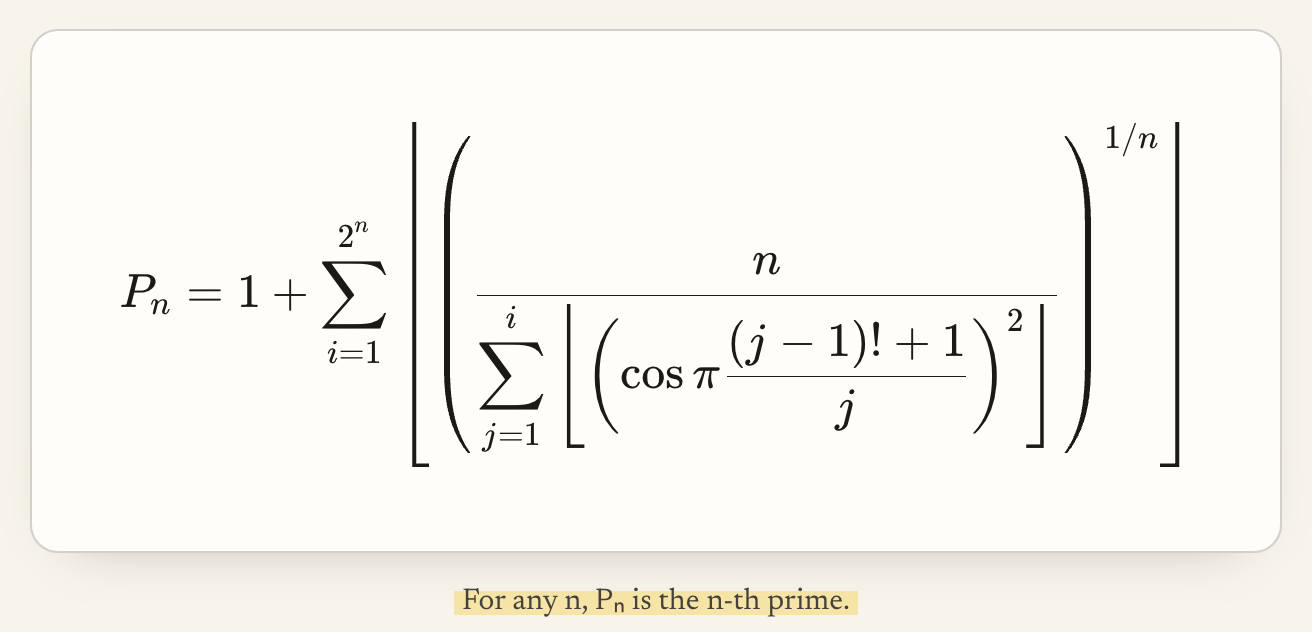
🔢 In 1964 C. P. Willans wrote down a single closed-form expression that returns the n-th prime number exactly. It leans on Wilson's theorem to spot primes and stacks floor functions and a cosine to count them. The formula is perfectly exact — and gloriously useless to compute — but it settles a quiet question: yes, such a formula exists.
🏛️ The International Congress of Mathematicians, held every four years, takes place in Philadelphia on July 23–30. The dates of the congress, which the U.S. hosts for the first time in 40 years, were chosen to coincide with the 250th anniversary of the Declaration of Independence. The Fields Medals, often called “the Nobel Prize of mathematics,” will be announced at the opening ceremony, and on July 24 Terence Tao will give a public lecture titled Mathematics in the Age of AI. The congress is not without controversy. Citing discriminatory visa practices, more than 2,400 mathematicians from 76 countries have signed a call to move the congress outside the U.S. The irony is that the Fields Medal itself emerged a century ago to reconcile mathematicians divided by the First World War.
📕 Fields Medalist Terence Tao is writing a mathematics book for a general audience for the first time. Due out in November 2026, Six Math Essentials will cover six ideas that have guided mathematicians throughout history. For Tao, mathematics is more indispensable than ever in the modern world, yet it has become needlessly intimidating and opaque in the public eye.
🥒 Stick two electrodes into a pickle and plug it in, and one end glows bright orange. The reason behind this decades-old trick is only now being understood. A pickle conducts electricity because it has been sitting in brine. A team at Portland State outfitted a pickle with a high-speed camera and a hydrogen sensor and ran both alternating and direct current through it. Electrolysis occurred in both cases, but the glow appeared only with alternating current. Why only one end glows has a simpler answer. When the pickle stands upright, the brine sinks to the bottom, so the lower end glows.
🏞️ America’s national parks drew 323 million visits in 2025, and 26 parks set their own records. Bloomberg has put together a crowd-avoidance guide covering 16 parks one by one. Using AllTrails’ anonymized hiking data, weather patterns, and tour operators’ advice, they worked out the best week for each park and its least-walked trails. Early October at Yosemite, late October at Zion, mid-January at Joshua Tree. A few kilometers past the famous overlooks, the parks are still empty.
🎬 Hans Zimmer once gave a concert in Dubai called Diamond in the Desert. Martin Timko has stitched together the best moments into a single video. Concert recordings of the scores from Dunkirk, Gladiator, Interstellar, Dune, and The Dark Knight are all in one place. Content well worth this month’s internet bill.
💬 “I have always imagined that paradise will be a kind of library.” — Jorge Luis Borges. The weight of the line comes from the moment it was spoken. When Borges became director of the National Library of Argentina in 1955, he had almost entirely lost his sight. A man who could read none of them had been placed at the head of nine hundred thousand books. In a poem he would call this God’s giving him books and darkness at once.
👓 The human eye is literally changing shape, and experts are baffled. Today one in three people is myopic, and by 2050 half the world’s population, some 4.8 billion people, is projected to be nearsighted. The culprit is usually not the lens but the eyeball growing too long. Intensive schooling and time spent indoors are the two environmental factors that stand out. Bright outdoor light prompts the retina to release dopamine, which keeps the eyeball from elongating too much. When Taiwan sent preschoolers outdoors for at least two hours a day in 2010, its myopia rate reportedly fell by half.
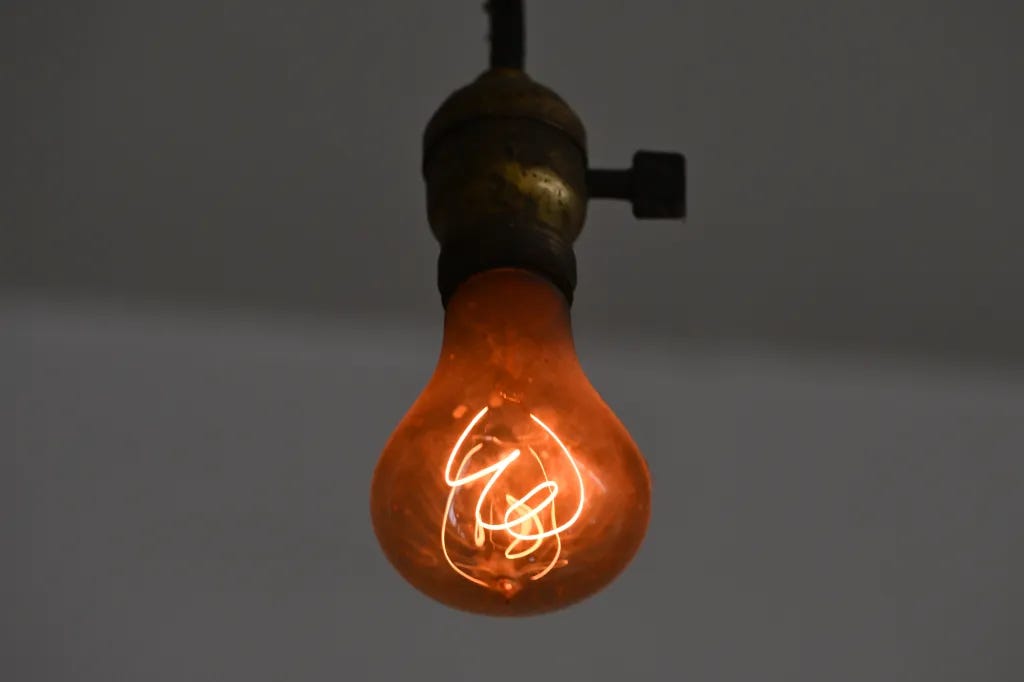
💡 The world’s longest-lived light bulb has been burning since 1901 in a fire station in Livermore, California. Handmade by Shelby Electric with a carbon filament, the bulb has been on duty 24 hours a day for over 120 years, going dark only a handful of times since. Guinness has officially declared it the world’s longest-burning bulb. The secret to its longevity is its low wattage and the fact that it is almost never switched off. It reportedly started at 60 watts and now glows as dimly as a 4-watt bulb. If you like, you can watch it yourself on the live camera on the site.
📱 Lenovo has released a phone that puts learning ahead of entertainment. Sold in China for 299 yuan, about 44 dollars, the AI Student Phone deliberately leaves out games, the browser, and social media. An AI assistant, opened with a dedicated side button, answers a student’s spoken questions and helps with homework. Parents, meanwhile, can track location by GPS and define safe zones like school and home, getting a notification whenever the child enters or leaves. A solution designed for families looking for a first phone, one that keeps kids connected without forcing the endless distractions of the modern phone on them.
🏭 Polarized America has finally found something it agrees to hate: data centers. According to a Gallup poll, 71 percent of Americans, including a majority of Republicans, oppose these enormous facilities increasingly filling the countryside. Data centers never shut down, consume vast amounts of electricity, draw millions of gallons of local water for cooling, and produce air and noise pollution all day long. According to Data Center Watch, there are now 833 protest groups across 49 states, and more than 75 projects worth 130 billion dollars were blocked or slowed in three months. The catch: once built, the facilities employ only a few dozen people.
⚡ The data-center boom first brought work to the American steel industry, and now it is bringing an energy crisis. Electric arc furnaces are now the dominant method of making steel in the U.S., and they are eyeing the same resource as the data centers. Ohio-based Metallus has seen its electricity costs rise 70 percent since 2024. On PJM, the country’s largest regional grid, wholesale power prices jumped 76 percent in a year. By 2030, data centers are expected to consume up to 15 percent of U.S. electricity. The strange part: the data centers themselves eat a million tons of steel a year.
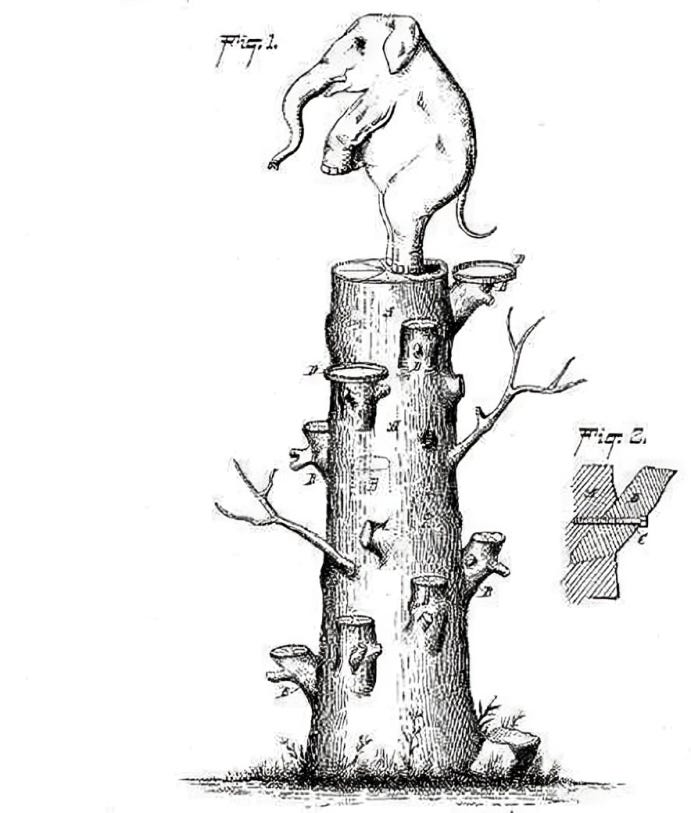
🐘 In 1891, Hermann Reiche patented a platform to enable an elephant to climb up a tree. The drawing shows logs arranged like steps up a pruned trunk, with an elephant balanced on one foot at the top. It was designed for a circus act, but what endures is the question itself. No one thought elephants needed to climb trees; Reiche did. The line attributed to Galileo fits well here. Doubt is the father of invention.
🏃 Hitting the wall in a marathon means running the second half 20 percent slower than the first. A study that combed through data on the 873,000 runners who have finished the Berlin Marathon since 1999 shows this happens to men twice as often as to women. And the gap widens among the fastest runners. Among men who run under three hours, the risk is six times that of women at the same pace. Across the 27-year archive, the gulf never closes. Men finish faster but pace the race worse.
☕ Good news for coffee drinkers. According to a new study that tracked 13 years of health data on 355,000 adults, coffee is inversely associated with death from liver cancer and cirrhosis. Among those who drink five or more cups a day, the risk of cirrhosis drops by a third and the risk of liver-related death falls by 42 percent. The benefit appears even at one or two cups but is strongest at three or four. When the same effect showed up with decaf, it became clear that caffeine is not the sole hero.
👧 It is common knowledge that political views flow from parent to child. A new study shows the reverse is also possible. According to a social survey conducted in Japan between 2000 and 2018, fathers whose first child is a girl reject traditional gender roles more, and support reforms expanding women’s rights more, than fathers whose first child is a boy. Because the sex ratio at birth in Japan has been stable for a century, the sex of the first child is genuinely random, which turns the study into a natural experiment. The effect is limited to gender equality; the same fathers’ views on immigration or security policy don’t change at all. Raising a daughter doesn’t make a father more left-wing in general, it just opens his eyes on one issue.
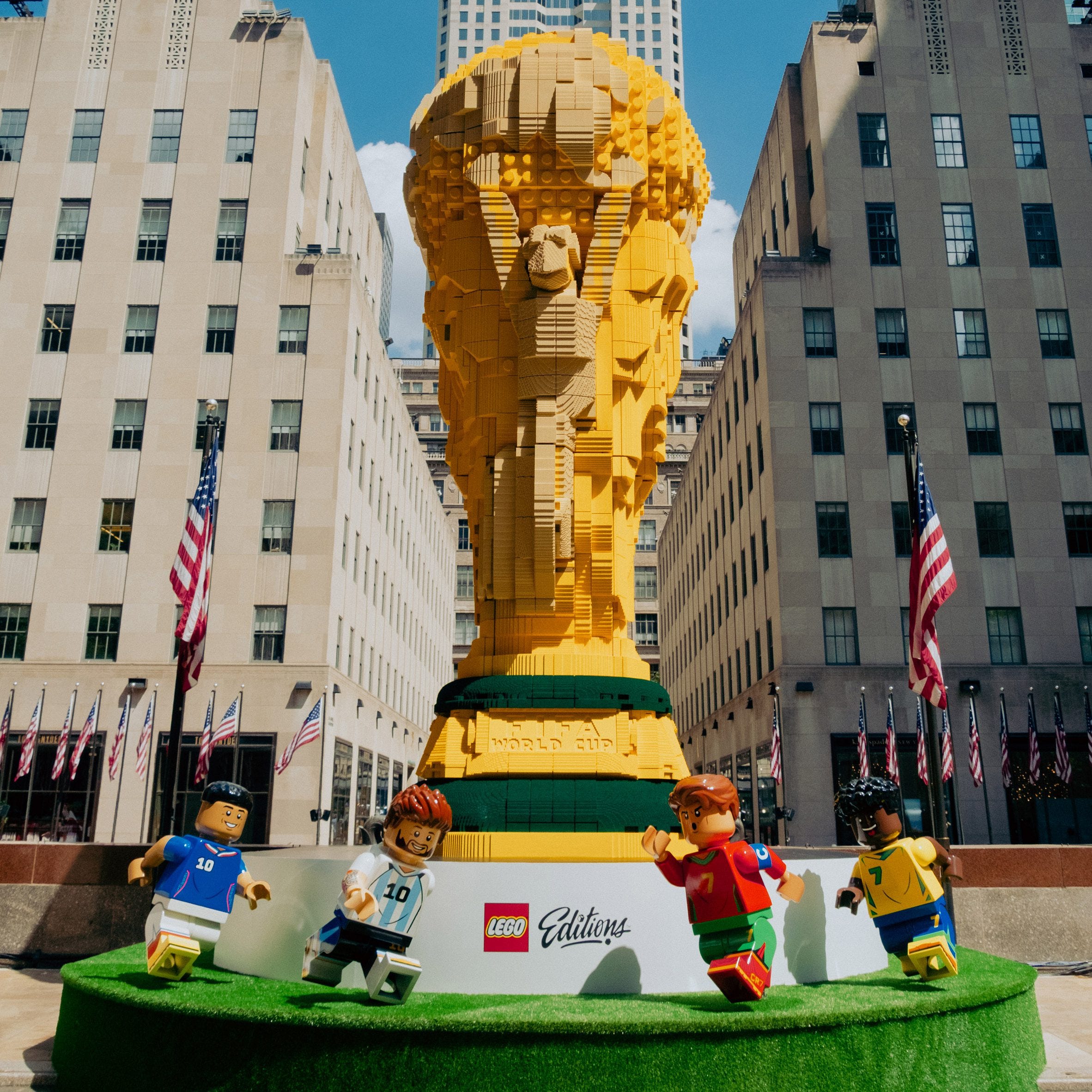
🏆 Lego has erected an 8.4-meter World Cup in front of Rockefeller Center in New York. Built at 25 times the size of the real trophy, the model is made of 1,360,000 bricks and is one of the largest Lego structures ever built. It is fitted over a steel frame and was transported to the site in 16 large sections. According to its designer, the hardest part was the trophy’s organic shape, and capturing the soft curves with the angular grid of bricks took quite a bit of effort. Production took eight months.
🐦 Britain has lost 73 million wild birds over the past fifty years. The Guardian gathered the calls of species representing each decade and reconstructed the dawn chorus of 1976. Listening backward from today, the sound grows steadily more crowded. The house sparrow population has fallen 72 percent since 1976, the starling population 88 percent. Back then both were abundant enough to be considered pests. Researchers call this the shifting baseline. Each generation measures loss against the impoverished state it was born into. Today’s child doesn’t hear this silence as silence.
🦟 It was estimated that there are six million insect species in the world. A new study says the true number is at least 14 to 30 million. The team analyzed the DNA barcodes of more than 1.6 million insects collected from a conservation area in Costa Rica. Every different method converged on the same place, and cryptic species, too similar to tell apart, are far more numerous than expected. By a conservative estimate, 93 to 97 percent of insect species are still nameless. One researcher’s question lands well. If you don’t know what you have, how will you protect it?
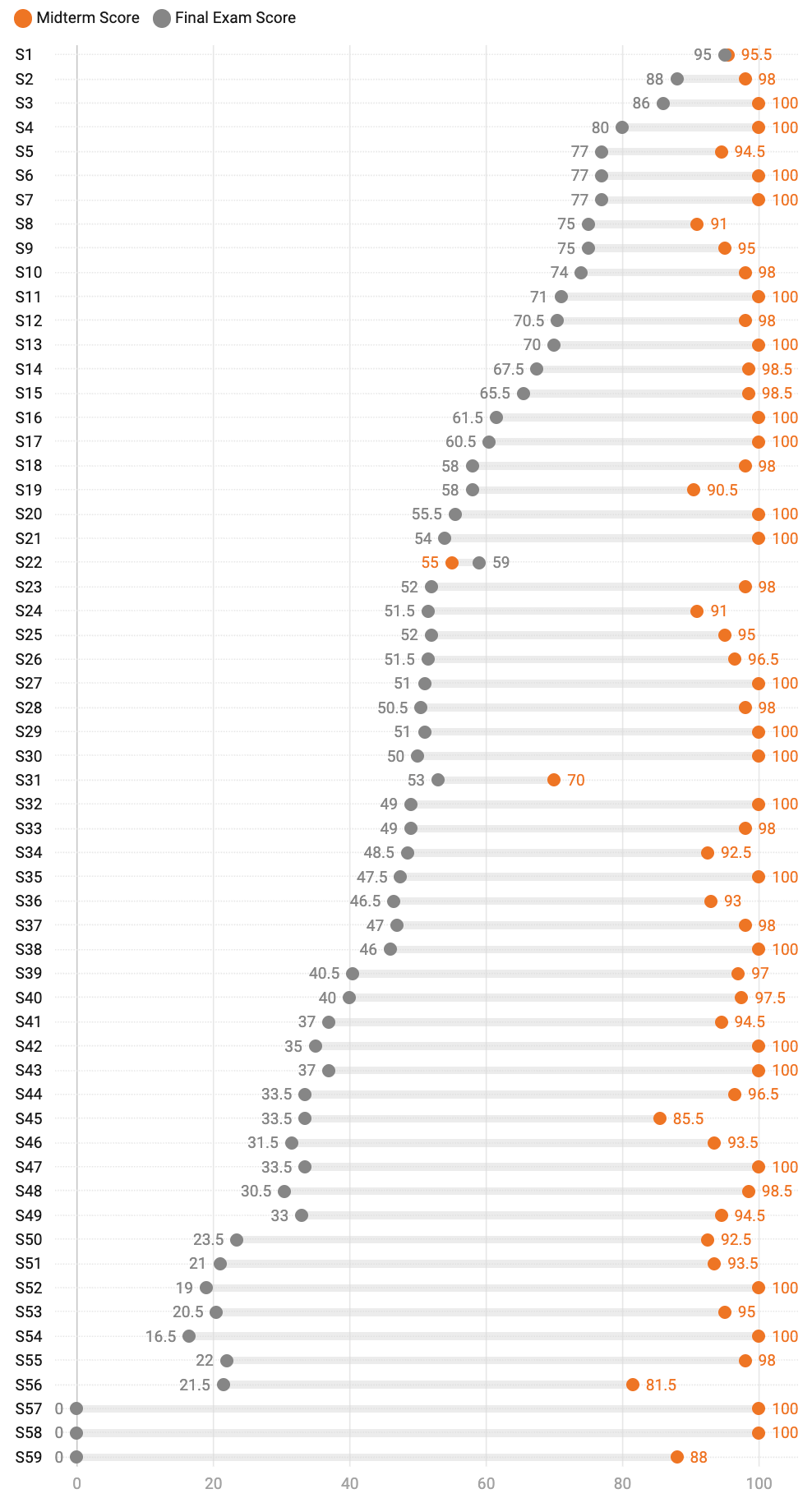
📝 Last week we shared that Roberto Serrano, an economics professor at Brown University, suspected most of his class had cheated with AI. Now what the professor described has been charted out. Serrano gave the midterm as a take-home and held the final in class, under his own eyes. Nearly all 59 students scored close to 100 at home but dropped below 50 in the room, three of them scoring zero. A single student scored ninety-five on both exams.
🛒 Tony Barzar is a cashier who earns 33 dollars an hour at Costco, and he is now a millionaire. Forty years in the same job, forty years putting small amounts into the same 401(k), his savings have passed a million dollars. According to the Wall Street Journal, Costco pays well above the industry average to keep its long-tenured workers. Its turnover after one year is 7 percent, far below the industry average. Barzar has turned down offers of promotion; he likes mentoring without being a boss. “This is where I belong,” he says. The math of it is interesting. Keeping a worker happy turns out to be cheaper in the long run.
🚁 Male dragonflies defend their breeding territory like fighter pilots. According to a study, these aerial dogfights turn out to rest on surprisingly simple, vision-based rules. Both dragonflies try to get behind the opponent and claim the advantageous position, exactly the way fighter pilots go for the tail. They can pull turns of up to 6 G but don’t push their speed for the sake of maneuverability. The findings could pave the way for smarter drones that fly on simple visual guidance rather than heavy computation.
Your work is very interesting. Tbh, I am not much of a mathematician, but I always see something new.
Thank you!😘