
Beyond Euclid #229
Welcome to Beyond Euclid #229, the newsletter for the best mathematics and science stuff of the week. I am Ali, and I curate cool math and science stuff every week to help you have a better week.
Hello from Beyond Euclid 229. Let me say it up front. This is the last issue I send out completely free.
Here is the reason, plainly. I write this letter after my children are asleep, and every issue costs me real hours. I read a lot, keep a little, check all of it, and cut it down so it is worth your few minutes. The only thing that makes those hours possible is reader support, and right now a very small number out of fifteen thousand people carry it for everyone. On top of that, there is this. Some newsletters regularly take the things I spend hours filtering and arranging, and run them in their own issues. No work on their side and no cost either. I let it go for a long time, but it has started to wear on me.
So here is how it will work from now on. The first two or three items of each issue will stay open to everyone, and the rest will go to supporters. On top of that, once a month I will write a special issue built around a single theme, for supporters only.
You can move to a paid subscription on Substack. If you would rather not do it there, Patreon works too. Both cost less than a coffee. And if supporting is not possible right now, do not worry about it at all. Sending this letter to one person who would love it genuinely helps.
🌀 John Edmark teaches design at Stanford and makes sculptures that hypnotize you. He calls them Blooms, and under a strobe light they keep opening and never stop. The trick is in how the petals sit, because each one is placed 137.5 degrees from the next, so your eye catches the following petal with every flash. Plants space their leaves around a stem at that same angle. That is why a perfectly grown pine cone starts blooming too when you spin it at the same speed.
📐 Algebrica is the best math resource I have seen in a long time. More than two hundred and fifteen entries at university level, all written from scratch. No ads, no courses for sale, no gamification tricks like badges and streaks. The interface is plain on purpose, because it is built to protect your attention rather than grab it. Antonio Lupetti has been writing all of it on his own from Rome since 2023. There is not much work left on the internet this quiet and this patient.
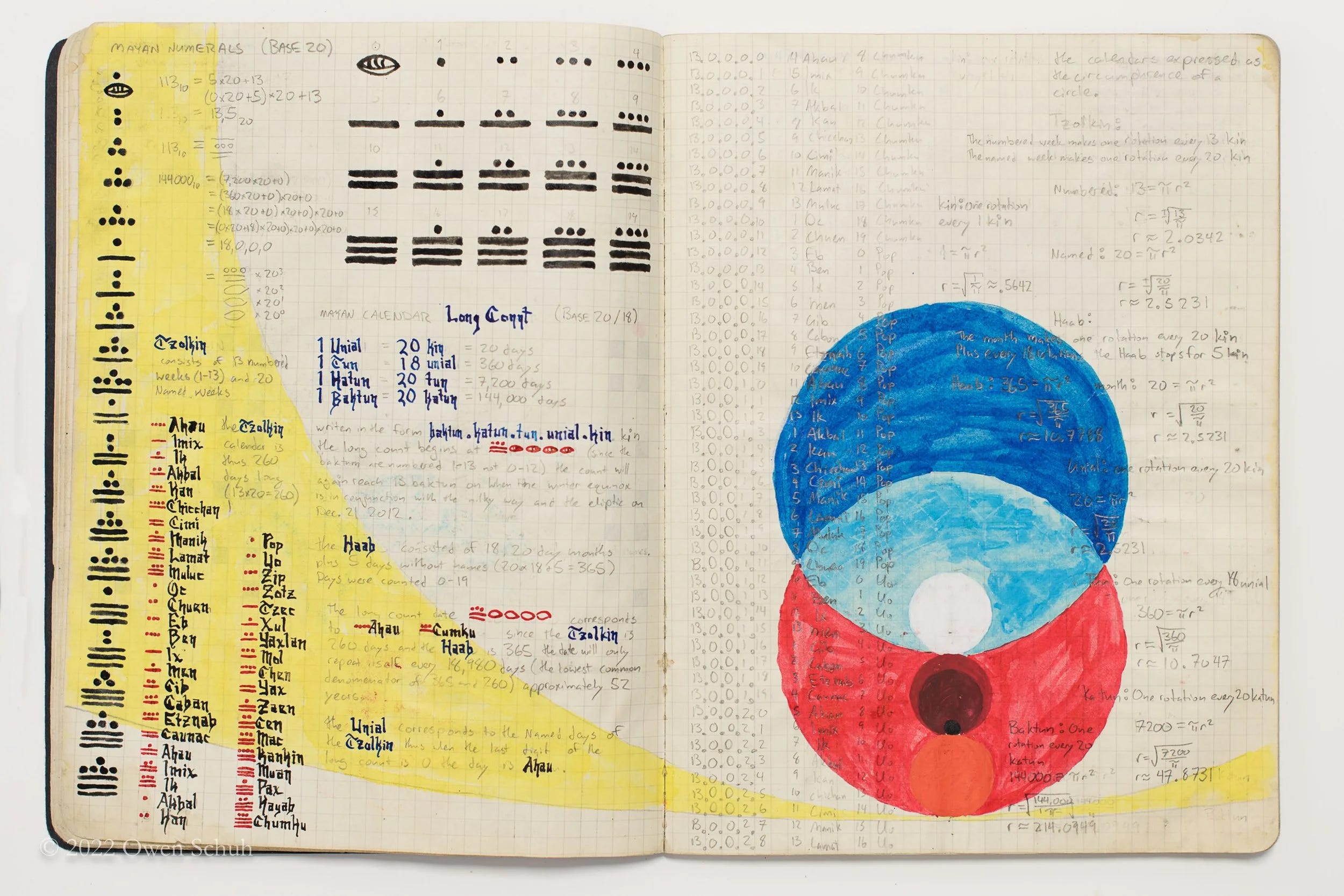
📓 Owen Schuh’s math notebooks made me look. Graph drawings on grid paper, colored nodes, calculations squeezed into the margins. A good notebook is the closest thing to looking inside a mathematician’s head.
🪙 You have two options. Either you take 50,000 pounds right now, or you flip a coin for a fifty-fifty shot at a million. Of the 4,600 people surveyed, 73 percent took the guaranteed money. The coin flip is worth 500,000 pounds in expected value, which is ten times the safe option. The math could not be clearer, and people go the other way anyway. The split is interesting too. Among women, 82 percent took the sure thing, against 63 percent of men. One in four people aged eighteen to twenty-four will take the risk, and among the over-sixty-fives that drops to 11 percent. The reason is well understood. We feel a loss much harder than a gain, so the fear of walking away from 50,000 with nothing drowns out the thrill of maybe winning a million. Expected value works on paper, but life gets played once.
🖼 Here is another one that pays your internet bill back to the penny. The Last Museum has pulled together dozens of the open collections I have shared here over the years and gathered 5.8 million works in one place. The site does not own a single piece itself. It takes the records that thousands of institutions have opened up and lays them out in front of you. The best part is how you search, because you do not need to know the title or the artist. If a color or a mood comes to mind, you type that, and the site finds work that hangs together. Every piece links back to the museum that holds it, so you can grab the high-resolution version there. A museum that owns nothing and still contains everything.
🚀 The Cold War space race is now a four-part series called Once Upon a Time in Space. It is built on archive footage nobody has used before and on people who lived those days from the inside. The first three episodes are up on PBS right now. I have added it to my watch list.
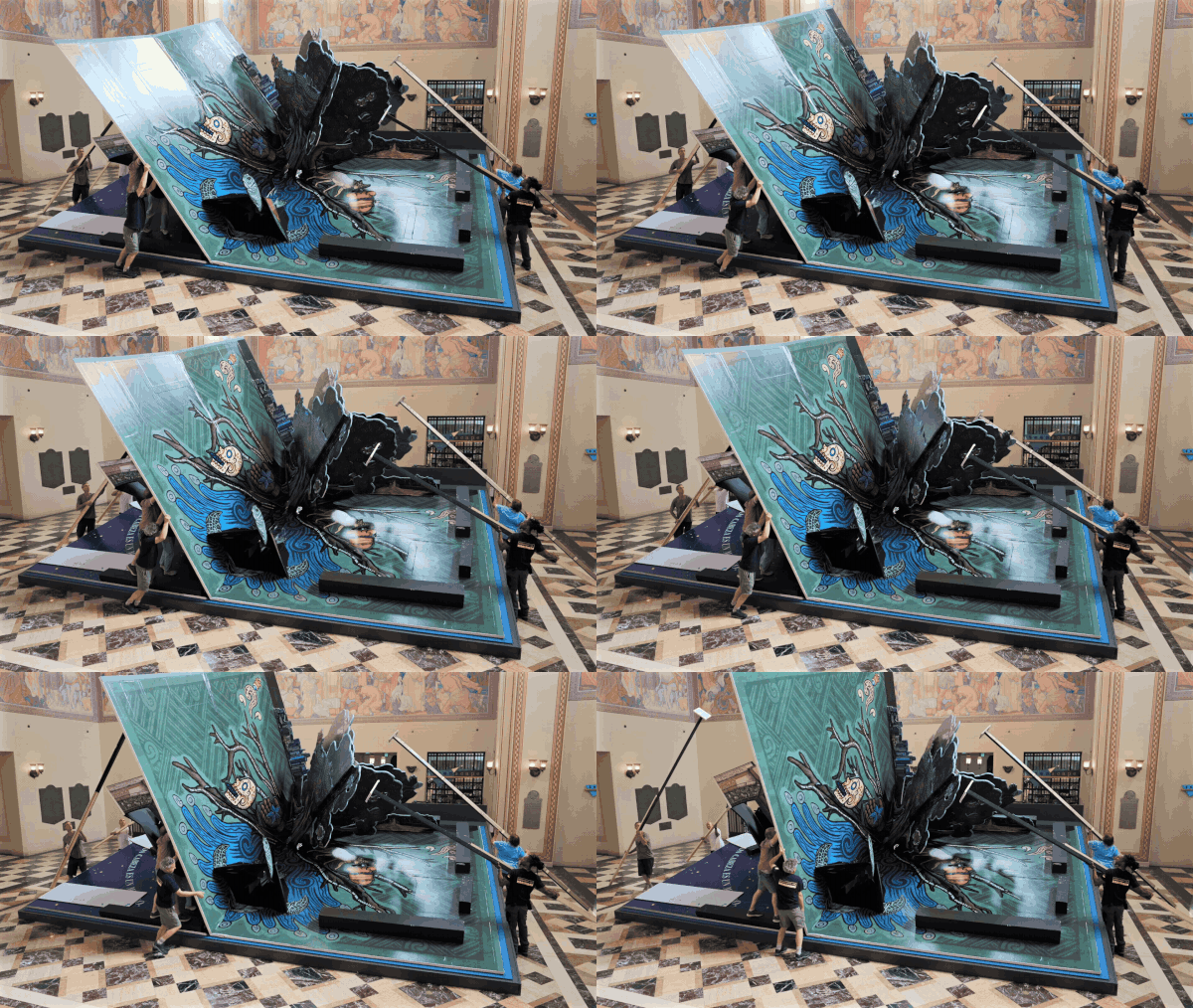
📖 Picture a book that weighs almost a ton and takes several people to open. The Los Angeles Public Library is marking its hundredth year with the largest pop-up book in the world. Daniel González designed it, and Luceros y Penumbras opens out to 9.5 meters by 6 and rises 3.5 meters. My favorite part is that the materials are no different from an ordinary book, just fabric, paper and glue. One spread has a big tree standing in front of the city skyline. The other has the library facade and a single sentence written in two languages. Each person is a library.
🌡 The heat has gotten so extreme that words no longer cover it. So Japan has added a new word to the language for the kind of heat old words cannot describe. Kokushobi, meaning a brutally hot day. On one of those days in Tokyo a few weeks ago, 453 people were taken to hospital with heat illness. God help us all, because August has not even arrived and it is genuinely brutal outside.
🌍 Speaking of extreme heat, I really recommend reading this piece on it by James Hansen at Columbia University. It will give you a much better scientific grip on how serious this is.
📱 Everything has lost its soul lately and almost everyone is chasing attention and performance. The other day I watched a woman who was attacked by a grizzly while hiking film the whole thing as it happened. That is not normal. So I pay attention to anything that tries to pull people back toward normal. Light is one of those companies, and this week they announced the Light Flip. A 299 dollar flip phone. It has a T9 keypad and a headphone jack, and it has no browser, no social media, no endless feed.
👓 I have worn glasses for about 30 years and I expect to wear them for life, because I love glasses as objects. That is why Brilliant Labs’ Halo has been on my mind for a while. But it is expensive, 400 dollars. If I ever buy smart glasses, I would rather try the open source Halo than hand money and data to that lowlife Zuckerberg. If you love glasses too, go take a look.
🌇 I learned something very interesting this week. You can see the Chicago skyline from the shore of southwest Michigan. There are 85 to 100 kilometers of lake in between, and the curve of the earth puts the city well below the horizon, so seeing it should be impossible. What makes it happen is atmospheric refraction, because when warm air settles on top of the cold air over the lake, light bends along the way and the buildings behind the horizon appear to float on the water. If they look upside down and strange, you are seeing a mirage. If they stand upright, it is called looming. The best time is around sunset in spring or fall. I liked that the thing pulling a whole city out from behind the horizon is nothing more than a few degrees of temperature difference.

🔋 We keep celebrating the news that electric cars are spreading, but their aging batteries are a huge problem sitting right there. Now scientists have worked out a way to turn those old batteries into fertilizer. The method rests on ion exchange, which has been used in water treatment for ages, because the lithium ions in the dissolved battery cling to a resin while potassium takes their place, and that recovers more than 90 percent of the lithium. What is left is a phosphorus-rich solution, and once you enrich it with nitrogen and potassium it becomes fertilizer. The whole process settles in twenty minutes. Next up is a field trial on an acre of tomatoes. So in a few years the tomato on your plate might come from an old car battery.
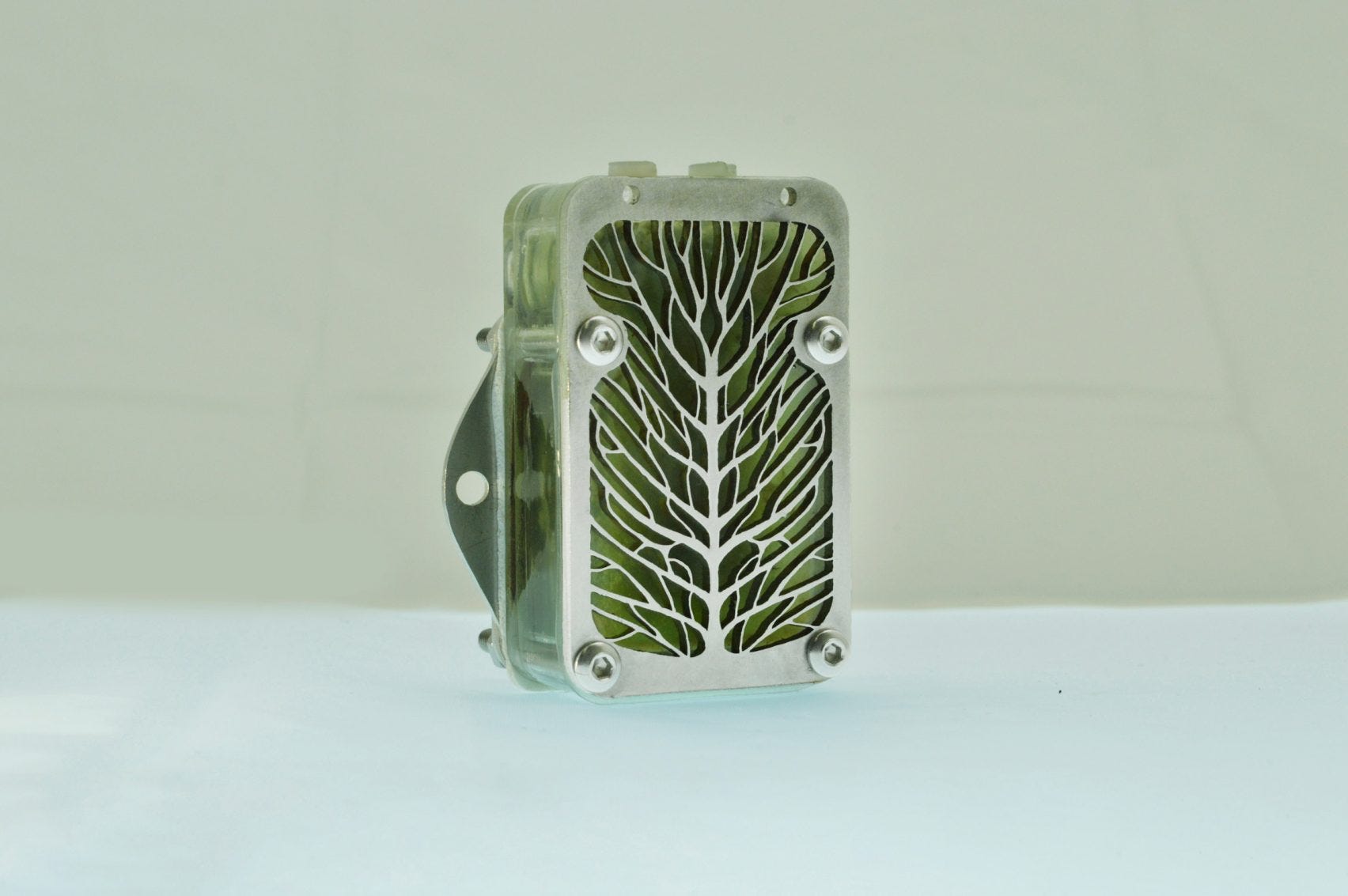
🌱 A team at Cambridge is about to pull off something wonderful, putting a living thing where an everyday battery used to go. What they are doing is very practical. They put blue-green algae inside a box they call a biocell, and the algae generate electricity for as long as they keep photosynthesizing. The goal is to wipe out the millions of single-use batteries that go into things like remote controls and smoke alarms. The box is transparent on purpose, partly because the algae need light and partly because they want you to see the living system inside. The algae are not harmed at all and keep producing power for their whole lives. The cell in the lab is past six years now. Thinking of a battery as hungry rather than dead is a strange and lovely idea.
🕳 Digging holes in the sand for hours was one of my favorite things as a kid, and now my own children do exactly the same. But I was shocked when I watched the video below, because this game, which looks like the most innocent fun in the world, turns out to be extremely dangerous. Damp sand can stand up like a straight wall, because the thin film of water between the grains holds them together. But that bond is very weak, and once the sand dries out a little it collapses all at once with no warning. The collapsed sand fills every gap, so even a few centimeters on your chest makes breathing impossible. So always fill in the hole you dug.
🔎 The internet is about to change at the root, because publishers that lived for years on the traffic Google sent them are now talking about shutting Google’s bots out of their sites entirely. A few years ago that would have been suicide, but traffic at some publications fell more than 40 percent in a single year and the math flipped. Google takes sites’ data to build its AI, and then cuts off their traffic and keeps it for itself. Sooner or later the EU will fine Google another two or three billion dollars and life will carry on exactly as before.
🔓 Last week, with no attack or breach involved, anyone running a simple Google search could read hundreds of Claude conversations for two days, because Google and Bing had indexed the chats of everyone who had not hidden them and were showing them in search results. My advice is to go through your privacy settings properly. Regret afterward does not help.
🧬 A six-year-old girl who became the first person in the world to receive gene editing, and who was used as something close to a test subject, sadly lost her life. There are a lot of striking details behind it. Her family spent 860,000 dollars to make the treatment happen. The side effects seen in the monkey trials were brushed aside. And if what is written is accurate, the most absurd part is that the hospital was fined 3,600 dollars for its negligence.
📰 A student in California, partly out of boredom and partly out of curiosity, wondered whether the rich people in his neighborhood had any link to that scumbag Epstein, so he combed through three million pages of federal archives and found thousands of connections by the end of the day. That was not enough, so he went and published it in the school paper, and things escalated. Just like everyone who was ever friendly with Epstein, the rich of that neighborhood insisted on their innocence and tried to come out on top.
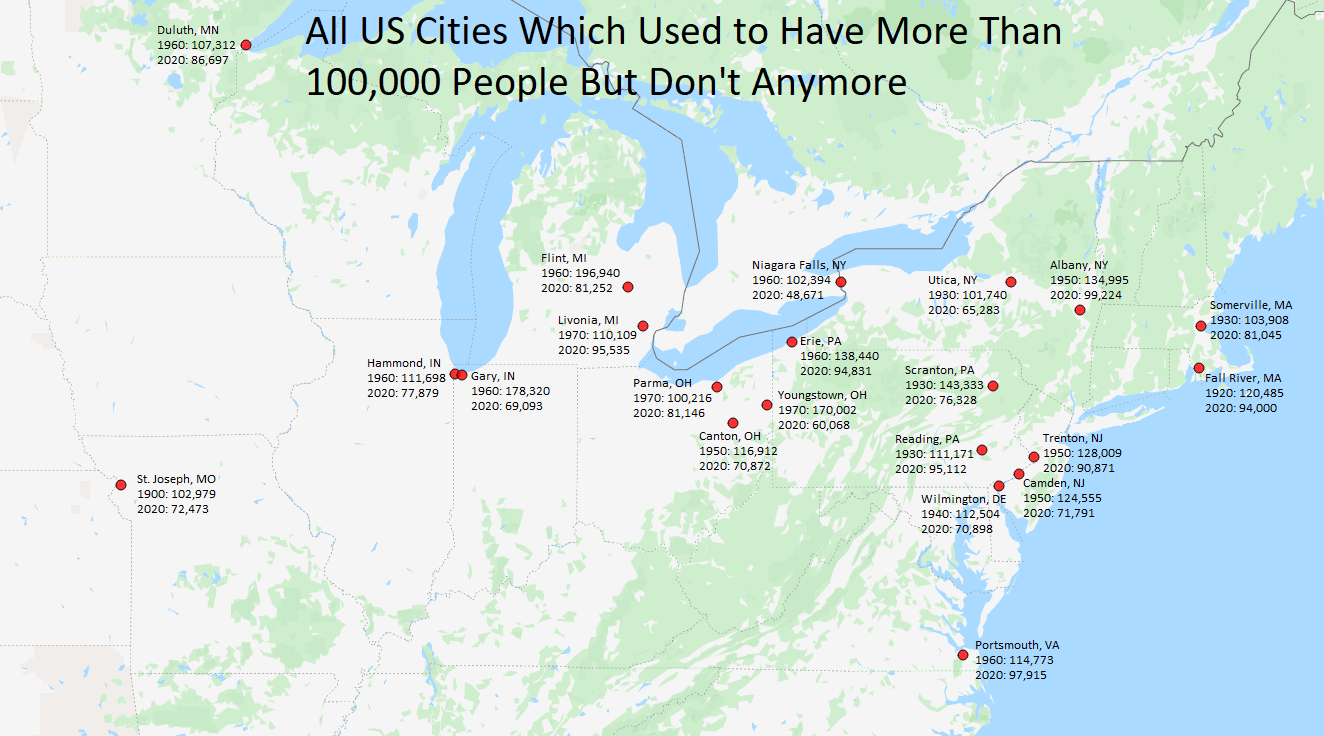
🗺 A map of every American city that once had more than a hundred thousand people and no longer does. Nearly all the dots sit in a single belt, and the peak years are squeezed between 1930 and 1960. So this is not really a population map. It is a map of when American industry peaked.
👟 Nike introduced a slide last week that heats and massages your feet. There is a pod on the midfoot strap that holds on magnetically and comes off whenever you want, and it delivers three levels of heat and vibration across the top of the foot. The heat goes up to 47 degrees, the massage cycle runs fifteen minutes, and it charges over USB-C. The design is lovely and it costs 250 dollars. But a few things do not add up for me. If someone is wearing slides outdoors then it is already warm and they do not want hot feet. And if they are wearing them around the house in winter, is 250 dollars not a lot?
💶 The European Union has opened a public vote to redesign the euro. Every design on offer is gorgeous. One side of the proposals has major figures like Leonardo da Vinci, Beethoven, Marie Curie, Maria Callas, Bertha von Suttner and Cervantes, and the other has birds, rivers and the like.
🐋 Scientists have found something strange about sperm whales. When a ship passes nearby, the whales change the way they talk. Researchers put recorders on fifteen whales and gathered close to 1,400 pieces of communication data. They observed that the whales shorten their calls when there is ship noise. On top of that, the researchers could not tell what the whales were saying even from a few meters away. So they think the whales struggle to hear each other too when a ship goes by. Noise from shipping has risen at least thirty-two-fold on the main routes since the 1950s, which means the ocean is no longer a place where anyone can make themselves heard.
🦋 A child discovered that butterflies carry a memory that survives metamorphosis. He also observed that this memory passes to the next generation. Back in second grade the boy wrote a four-page letter to Martha Weiss, who studies memory in moths, and the two of them designed an experiment he could run at home. He taught some of the caterpillars to link the smell of lavender with a light vibration and left the others alone. Once they turned into butterflies, the trained ones avoided the lavender while the control group did not. He did not stop there. He bred the trained butterflies and noticed that the offspring, which had never felt a vibration, avoided the same smell. The boy who found all this was only ten when he presented his report at the International Congress of Entomology in Kobe in 2024.
☕ You have probably heard of Turkish coffee. It is a different kind of coffee that almost every tourist visiting Turkey ends up drinking. What makes it special is what the women say while claiming to read the grounds left at the bottom of the cup. It turns out the custom came about because gossip was shameful and forbidden at the time, and reading fortunes was invented as a way around that.
⚽ A reporter named Stuart Flinders was doing street interviews in Liverpool in 2015, asking people whether they remembered the 1967 derby at Goodison Park. When the old man he was interviewing described that match in detail from forty-eight years earlier, Flinders was surprised. The old man then said that he was the one who had been in the Liverpool goal that day. His name was Tommy Lawrence and he kept that goal for more than ten years. I came across this video years later and it made me happy. I hope it does the same for you.
The best yet! Great stuff.
Glad to be here and support this coolness!