
Beyond Euclid #230
Welcome to Beyond Euclid #230, the newsletter for the best mathematics and science stuff of the week. I am Ali, and I curate cool math and science stuff every week to help you have a better week.
Welcome to Beyond Euclid 230, the newsletter where I gather the best mathematics and science of the week. I am Ali, and every week I sift through what I read so that it is worth your few minutes.
In 229 I wrote that something was going to change. It has. This is the first issue under the new arrangement, and my thanks go to every single one of you who chose to support it; this letter gets written entirely because of you. If you would rather not use Substack, you can support it on Patreon instead.
A good deal has piled up this week. The geometry book list I wrote from scratch again, junk falling from the sky, a humanoid robot walking into a classroom, an armchair that grows in your garden, the collapse of an iceberg from beginning to end, and a security robot balancing on a single wheel. Happy reading.

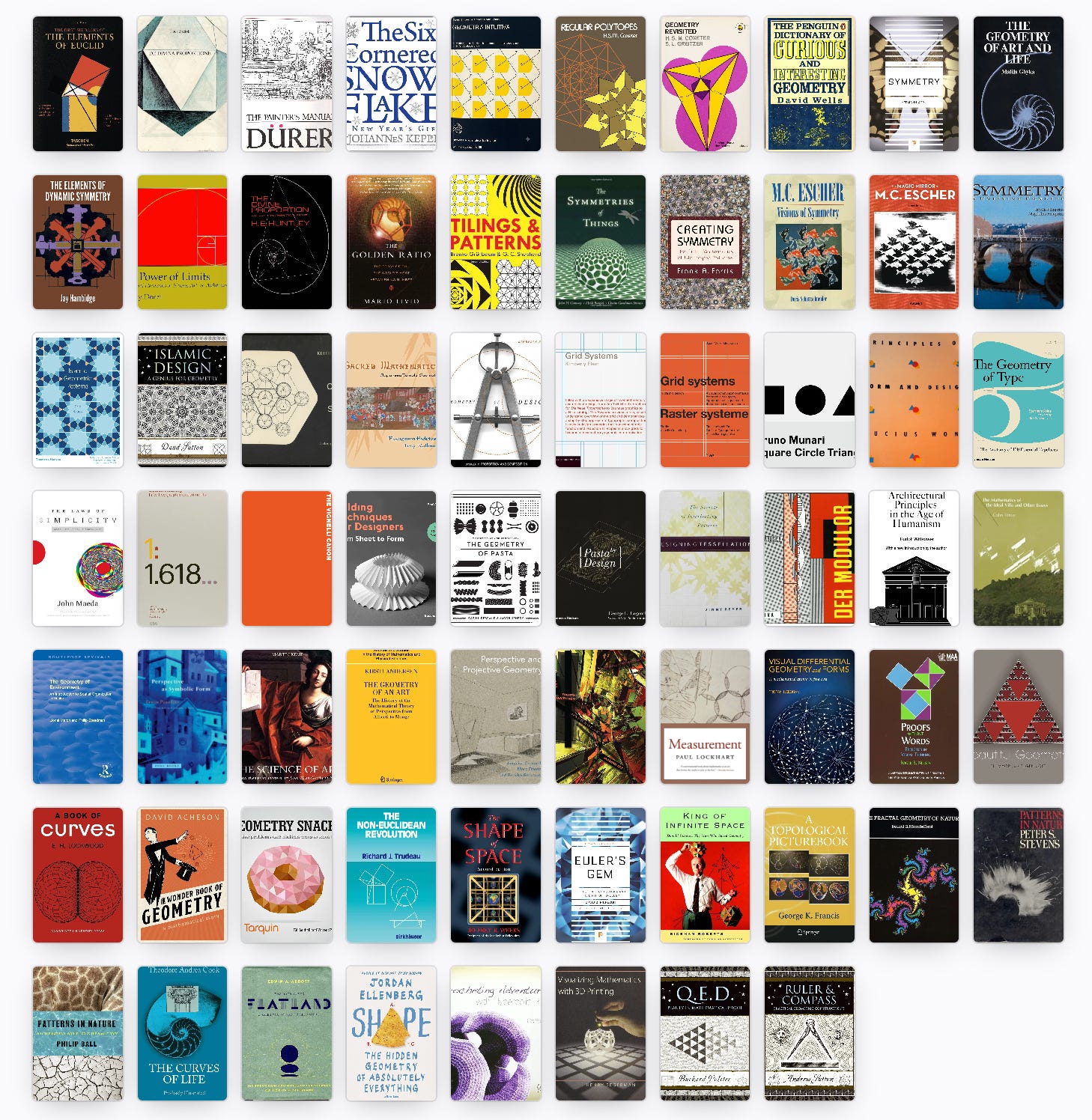
📐 The geometry book list I put together a while ago was lost in a file accident. I wrote it again, and this time, instead of trimming it, I expanded it and the list grew fourfold. Sixty-eight books, six shelves, from 1509 to 2024. While putting it together I noticed this: the libraries of mathematicians and designers overlap far more than I thought, and the name of that intersection is geometry. It opens with Byrne’s Euclid printed in colour and closes with the pocket guide to the compass and the ruler. There is no need to read all of them; one book from the canon plus two from the shelf closest to your own work is enough to start.
🛰️ Humanity now has a brand new giant problem. Space junk falling from the sky (it sounds utterly absurd) is expected to kill 1-2 people a year ten years from now, because ten years ago 110 pieces of junk fell to Earth, and last year 820 did. And by junk I don’t mean a cigarette butt; I mean a piece at least as big as a horse and extremely hot. There are other problems too. For instance, if a piece falling into the atmosphere is off by 1 minute, it drifts 300 miles from its trajectory. If you remember, this past January the chance that an 11-tonne-ish Chinese rocket part would come down somewhere in Europe caused a huge panic. Finally, if a piece of space junk damages your house or your property, you cannot claim any compensation. Completely ridiculous, but unfortunately true. Parts of a French rocket launched 16 years ago fell on a village in Kenya and nobody paid anybody any compensation.
🤖 A small school district on the Seneca territory in New York has become the first district in America to put a humanoid robot in the classroom. An AI assistant called Optio provides homework and review support through avatars trained on the district’s own curriculum, while an M-series robot is positioned to interact in the classroom through speech and facial expressions. For now the pilot is limited to students taking robotics classes, and the plan is to expand it to around five hundred high school students in the fall. As if that weren’t enough, to draw children in even further, the robots will have TikTok and Instagram accounts that they will actively use. As someone who works with school technology, I watch this kind of project with great caution, because what works in the classroom and what looks good on social media usually turn out not to be the same thing. Something that goes against human nature can never bring any good to humanity.
I have written about the AI curriculum question in schools before. Two investigations into Alpha School, which charges seventy-five thousand dollars a year, produced a detailed report on AI lesson plans that had been flagged internally as problematic, camera surveillance reaching into students’ homes, and the absence of any independent data confirming the promise of twice the learning. Anyone curious can read the details here.
📡 You can trace dark matter in the universe with a simple setup at home. Spending less than 50 dollars, an engineer observed that mysterious thing called dark matter at his house using roof flashing, an emptied paint-thinner can, an amplifier and a small radio receiver. And he wrote up that observation in a very simple and detailed way. A superb piece and a superb experiment for anyone curious.